PUBLISHED IN THE HARVARD REVIEW, ISSUE 63
Naupa
THE WINTER my father was hospitalized, I began to see hawks. It was the second year of the pandemic, so everything was weird, including me. My days were spent sitting at a desk in my closet, chained to Zoom calls until well after dark. While I took these calls, I would scan the grey corner of the world framed by my window, hoping for the rush of dopamine that came from spotting the birds.
On the rare occasions I left the house, my eyes began to sweep the treetops of the outside world. I suddenly noticed hawks everywhere. I wasn’t sure if they were a new apparition, or if I just hadn’t been paying attention before. In Prospect Park, I saw them in the branches high above the Nethermead; driving upstate, I saw them sitting on the electrical wires along the highway. On my way to get a mammogram, I made out a yellow-footed raptor atop a lamppost surveying an intersection in Queens.
Once my father died, I began to read about hawks, which I felt were connected to him. In many cultures they are considered mediators between this world and the realm of the spirit; they are also messengers of change. It was simple enough to parse their parallels to my dad: like him, they were a tangle of contradictions, apex predators covered in soft, fluffy feathers, incredibly tough but also fragile. They were entirely out of place in the city, and yet here they were, going about their lives despite this misalignment. However, they were free while he was not.
***
In November, my father, then in his late seventies, rang a neighbor’s bell and collapsed on her steps. Two days later, I received a call from the hospital where he had been taken; they had not known initially who to notify or what was wrong with him. It took a few more days to determine that he’d experienced a drug overdose. A short time after that I opened an email with the subject line Drugs Your Dad Is Taking, which included a list of opiates, benzos, and amphetamines so long I had to scroll several times before I reached the end.
For most people, the news that their elderly father had overdosed on drugs would be a shocking call to receive. But for me none of it was a surprise, a fact that left me feeling removed from the responses coming in from those around me. In the days following his hospitalization, I received a sympathetic call from someone at my corporate job. He’d heard that my dad was in the hospital and asked if he was going to be okay. When I said I didn’t think so, he turned confessional and said that he could relate because he was going through the exact same thing.
As he told me this, I was standing by the window, looking for hawks. My phone buzzed, and I glanced down. My half-sister had sent a message casually informing me that our father’s apartment was infested with bedbugs. I thought of the corporate guy with his Waspy name, whose Linkedin noted that he had been captain of his college lacrosse team, and found myself doubting that his dad’s situation was the same as mine. At least, for his sake, I hoped it wasn’t.
***
Should I tell you how good my dad was? Or how bad? How broken he was? Or how he broke me? My father would not live to see eighty. When he died, I tried to write something to memorialize him. Wanting to be truthful, I wrote that he was a very interesting man, but not a very good father.
The first part is true. The second is an equivocation: he was a terrible father. When he died, we had not spoken regularly in almost six years. My childhood was smeared by the oily thumbprint of his addiction, a lifelong affliction he had inherited from his parents and from theirs before them. I stopped talking to him for the first time when I was twelve. Not long after that he got sober and managed to stay that way for nearly two decades. Eventually, on that basis, we built a second relationship. He was an improved version of his still-flawed self, and I was a young woman with low standards for who I would let into my life.
The years we spent acquainted would turn out to be a liminal space. He relapsed just after my wedding, and by the time my own children came, engaging with him had begun to feel disorienting. While he was sober, I had learned to trust him, so when he said he would be somewhere (a holiday, my daughter’s birthday party, the celebration for my brother’s engagement), I believed him. When he didn’t appear (because he couldn’t get a taxi, or had overslept, or didn’t feel well enough), I suddenly found myself strapped into a depraved time machine, hurtling back into the childhood I’d worked so hard to escape. Time compressed. I wasn’t thirty-five, I was five, and I was standing at the door, waiting for a father who would never come to save me.
It was unbearable. The day after my older daughter’s fifth birthday—the fifth he had not shown up for—I found myself on the phone with him, crying about how he had let my daughter down, but really for all the ways he had let me down, and I did something I didn’t have the temerity to do as a child: I asked him to stop using. But he was an addict, and he did what addicts do best. He ran away. When he stopped calling, I was relieved.
I only saw him four times after that. He was conscious for two of them. Once was at my brother’s wedding; the second was at a diner. The waitresses there all knew my name, and those of my children, though by then he and I hadn't been speaking for almost two years. As we said goodbye, he tried to hug me tightly, and I pulled back. The last two times I saw him were in hospital beds, by which point he was already on his way out, heading towards what-ever was coming next. His incredible mind had begun to crumble, and his big, strong body was used up. His skin hung loosely on the bones, and his nose rose from his face like the beak of a big old bird. He was confused, still fighting, batting away invisible demons with what little strength he had left.
A week after he died, I heard a voice while I was sleeping. It was loud and clear and spoke directly into my ear.
Skye, wake up.
Following his directive, I bolted upright and sat there in the dark. There were no further instructions.
After that, I waited for him to come to me again. I wanted him to tell me more, to explain himself. Isn’t that what dead people are supposed to do? A few weeks later, I dreamed he was wandering down a street, as confused as a child. His brother Bob, who had died decades before him, finally showed up to take his hand and lead him away.
My father damaged me in ways I’ve spent my entire adult life trying to undo. And yet I loved him. I can’t entirely tell you why.
***
There is a photograph, taken when I was a small baby. In it I’m propped up by pillows on a red velvet couch. I can’t yet sit up on my own. Between my legs is a can of beer, which is more than half the size of my body, and both my hands are touching it. My head is listing to one side; I can’t hold it up yet either. My father leans down over me. He is holding a joint, blowing smoke into my face.
My mother told me how she left me alone with him for the first time when I was a few months old.
Months? I asked, incredulous.
Oh yeah, she said, I really tried not to leave you alone with him.
But on this day she had to, and so she hurried to the store. When she came back, she could hear me screaming from up the block. Running inside, she found my father at his keyboard, playing music with his headphones on.
John, she screamed, pulling them off, the baby is crying.
I know, he said. That’s why I’m wearing headphones.
This story was told to me for the first time soon after my first daughter was born. I was raw in those twilight days of new motherhood. The love I felt for her as soon as she’d arrived was so visceral it had reconstituted me. Like a caterpillar entering a chrysalis, I had turned to mush and emerged as something entirely new. Whatever I had been before was lost, and my thin new skin was as fragile and unfamiliar as the tiny creature I held all day.
As I spent my nights nursing her, I would sometimes envision the life force pouring from my body into hers, imbuing her with whatever she would need to survive this world.
By the time she was four months old, I was cast sideways with sleep deprivation, hallucinating that the plants were moving. So we sleep-trained her. As she cried that first night, I stood outside her door and wept. My partner had to talk me out of throwing it open, wrapping her in my arms, and spending another night together awake, just to stop her tears.
I didn’t, and that night we both finally slept. The next morning, I found her smiling in her crib, neither scarred nor broken.
It is this feeling I remembered when my mother told me the story of my father, headphones on to drown out my cries, and me, all alone, next to him. No parent who felt about their child the way I felt about mine could wear those headphones—but he could, and he did.
***
The first thing my father would tell you about himself is that he was a musician. And that is what he loved most. As a teenager in Memphis, he discovered folk music and the Delta Blues and became a charismatic performer with a lovely, round voice—a self-taught master of the guitar, banjo, piano, and harmonica, and a talented songwriter.
My mom met him out listening to music. Instead of watching the band, she told me, they spent the whole night sitting at the bar, talking for hours. A lanky six-foot-six, he had broad shoulders and long legs and looked like a million bucks in anything he wore: the Hawaiian
shirts he performed in with his band, the soft flannels and jeans that were his work clothes, the fedora and suit with pocket square in which he cleaned up beautifully. He was handsome, especially so when he smiled or was on stage. It wasn’t just her; everywhere he went, women were charmed by him. I saw it with waitresses, cashiers, even my own friends. It was always the smart ones who were most drawn in.
According to the test he took when he joined the Army, my father’s IQ was 165. He read constantly and had a mind like a steel vault; he could hold forth on the basics of just about any subject. Before Google, if I had a question, however obscure (What political factors led to the Peloponnesian War?), I would call him and fairly reliably have an answer.
But I’m not sure I ever saw someone do so little with so much. My father took the hand he was dealt, full of promising cards—tall, handsome, talented, charismatic, with an intellect that would have allowed him to hold his own in nearly any room in the world—and folded. He didn’t even play.
Once, after they split, my mother used her savings to send him to Nashville to record with the best band he ever had. The night before the session, my father fired them all. It was a pattern in his life, like dropping out of college one semester short of graduation or staying sober for nearly twenty years only to relapse. Whenever he got too close to something good, he made sure to burn it all down before he could possibly flourish.
When I was small, he worked as a mover, then as a long-distance trucker. At one point, before I was born, he was a day laborer unloading cargo ships at the docks, a time I heard him speak about with nostalgia. Finally, at some point during my childhood, he joined the IBEW 164, the local electrician’s union.
All of which would have been fine if he’d loved his work, but he didn’t. One of the most heartbreaking things I found after he died was an inquiry he’d made, not long after getting sober in his forties, about transferring credits to a local community college. But he didn’t do it. Instead, he spent the rest of his life working his body hard doing dirty, complicated jobs: installing EZPass on the New Jersey Turnpike, later, replacing the giant exhaust fans that pump air from the Holland Tunnel.
When he spoke about what he did, it was with the detached tone of a sociologist tasked with studying a foreign tribe. My dad didn’t make friends with the men he worked with, and I can easily imagine why. I’m sure his conversations with them were the same as those with everyone else: soliloquies on whatever obscure subject had currently piqued his interest, punctuated by pauses to scribble in the notebook he always kept in the pocket of his flannel shirt, jotting down song lyrics and God knows what else. (After he died, I found myself flipping through these notebooks and failing to find anything in them that made any sense, to the extent that I wondered if he had somehow managed to hide being actually completely insane.) He was also the kind of guy who could find another man’s weak spot and pick at it, like the edge of a scab, getting under their skin—not to be mean but to keep his busy mind amused. But he was so big and tough that whether they liked him or not, men were forced to accord him a certain degree of respect, treating him as an alpha in a way he probably didn’t deserve.
One of the many things I don’t know about him is how his memory worked, but I do know it was photographic. Once when I was small, he recited The Hobbit to me, page by page, on a long car trip. The story took hours to unspool as he conjured it from the night air, finally winding down as we crossed the smokey Blue Ridge Mountains from Virginia into east Tennessee.
But that was once.
My parents’ marriage was short-lived. Charm only goes so far when there are children to feed, and his chronic unfaithfulness couldn’t have helped. My mother raised me and my brother alone on our father’s missing child support checks. Every other weekend, she deposited us at his apartment for two nights so she could breathe. While we were there, we rarely went outside. Mostly we watched television—The A-Team, WWF, the Saturday matinee—fetching bottle after bottle of Rolling Rock from the fridge as the sounds of car chases and gunshots blared from the set, until all the brightness and possibility of the day had faded away.
At night the TV stayed on, and he switched to horror movies: The Blob, Bad Seed, Night of the Living Dead and its sequels. These movies terrified me, and I wanted to run away. But I was torn. I also wanted to stay close to the warm body of my father, who smelled sweet, like clean clothes and beer, coffee and Red Man chewing tobacco. He was so big and strong that none of the monsters I was scared of could possibly get past him.
On those nights, when it was time to go to bed, I would ask him to sing to me, like my mother did. But he rarely would. Children were not his preferred audience.
Instead, I put myself to sleep. Curled towards the wall, my eyes wide, I would listen to him out there, drinking, raging. Then the monster I was most scared of was him.
It wasn’t all bad with my dad, but when so much is bad it can be hard to remember the parts that were good. Once he led us around his apartment on a parade, burning cedar chips in a cast iron skillet, singing and turning the skillet into a gong by banging it with a wooden spoon.
After I was grown, someone gave me a cassette tape, pulled from a shoebox somewhere. On it the two of us are reading from The Hobbit; he is Gollum and I am Bilbo Baggins, searching for the ring. My voice is still tinged with the Jersey accent I had as a child, his is deep and smooth. The tape goes on for twenty minutes, our voices alternating as we perform the scene with practiced drama that suggests it is not the first time. That happened. He took the time to sit with me and record that tape. I’m not sure if I remember it or if I just remember listening to it, but at least once that happened too.
***
There is another story, one I heard repeatedly during my childhood, where my father’s neglect was presented as a punch line. I would trot it out sometimes when I was a teenager or in my twenties, looking for a quick anecdote to offer a clue as to who I truly was by way of the kind of childhood I’d had.
My mother had a new job, working the graveyard shift as a typesetter for Rolling Stone. My brother and I were being watched by our grandmother, but on this night she wasn’t able to come, so our mother, with no other options, asked our father to come stay with us. I was two and a half.
At dawn my mother came home, and again the sound of screaming was audible from downstairs. In her bedroom, she found me sitting on her bed, crying, and my father next to me, passed out drunk.
I reported him to her, indignant: I don't like beer in my bottle.
In his stupor, he had reached over to the nightstand and topped me off with what was there, the beer curdling the remains of the milk.
***
These stories of him evoke a feeling that is familiar, unsteady. It is that of being small and aware that the person caring for you is not in control.
A few years ago, I took my daughter with me on a business trip to Lima. She was ten, and I’d arranged in advance with the hotel for an English-speaking nanny. But the agency had to send a last-minute replacement, and the woman who arrived spoke only Spanish. She was very young and very nervous, her starched uniform nothing more than a costume of competence. I could feel immediately she was going to be outmatched by my wild, almost feral kid. But what choice did I have? I had to go work, so I left them together, trusting they would figure it out.
Which they did, mostly. Despite my exhortations to the nanny in rudimentary Spanish that she was in charge, each night when I returned, it was clear my daughter was the one calling the shots. Her days were being spent on the hotel roof in the beating sun, where she practiced her diving for hours in the swimming pool, overlooking the Malecón below. She took no breaks, didn’t rest. Her only pause was to order room service—avocado toast, French fries, ice cream—which she ate poolside, while playing video games.
My daughter loves to swim, better than almost anything else. So she was operating on the addict’s assumption that if some was good, wouldn’t more be better? She didn’t yet understand that doing anything with no limits felt bad. She didn’t know how to be in charge of herself, and needed someone to tell her to pause. The stakes for her were low, thankfully. She was overtired, underfed, slightly unhinged. But I returned each night. When I did, I could feel her relief as she collapsed into me, gratefully relinquishing the power she was entirely incompetent to wield.
***
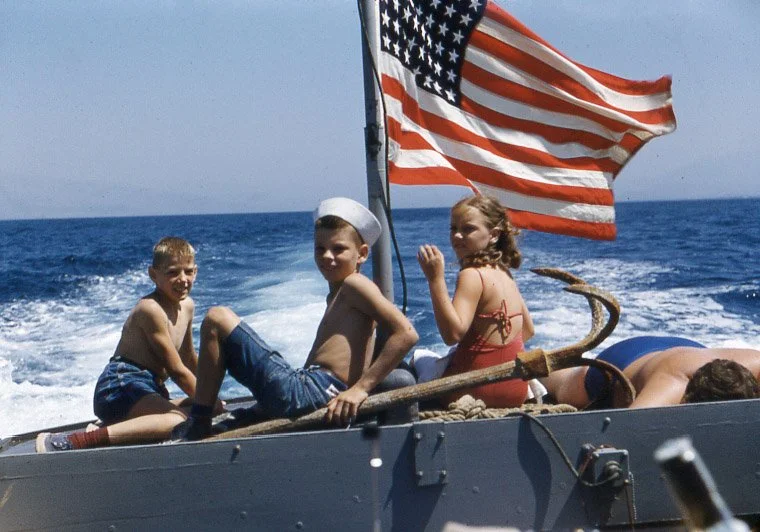
My father and two other children are on the back of a small boat, which is flying a big American flag. All around them is the deep blue Mediterranean. This is a Kodachrome slide taken by my grandfather, during the years he was stationed in Turkey. My father is about eight, shirtless and skinny, wearing long cutoff jeans and a real Navy-issue white sailor hat.
Of all the photographs I have of him as a kid, it is the only one in which he is smiling. In most of them he is gangly, standing awkwardly. Even when he is near a group, he seems to be slightly apart from it. He is behind the other children, his brow furrowed, his shoulders hunched almost to his ears. He is staring straight at the camera—or more likely, his father, who is holding the camera—with a nervous, expectant look.
There is another photograph taken in Istanbul. My father pointed it out to me. In the center of the frame is a Turkish man wearing a suit and black wool overcoat, smiling at the baby he is holding, who is my uncle. They are standing against the gray hull of a massive ship. Off to one side is my father, wearing a striped sweater tucked into belted blue jeans. His arm is curled around the top of his head against the sun, and the metal structure he is leaning into is the gangplank.
That was Mahmet, he told me. He raised me until I was ten. When my parents travelled he would take me home and I would stay with his family. That was taken the day we left Turkey. I never saw him again.
Most of the stories I know of my father’s life are sparse, particularly from childhood. They are shades, not photographs. Aside from Mahmet, all I know about his years in Turkey is that there was a trial that involved my father being molested by a man, or men.
Well, the Turks loved little boys, was all he would tell me. But he mentioned he had to testify.
After the family returned to the States, he told me was picked on. He got beaten up until his sophomore year in high school, when he went to live with his grandparents for a year and grew six inches. When he came back, he told me with pride, he beat the shit out of all the kids who had beaten him up the year before.
***
My father and I began to forge our second relationship when I was in my early twenties. By then I had gotten sober too, addiction one of my clearest inheritances from him. He had been sober for nearly a decade. Most of that time, I didn’t have his phone number. His second wife, a stepmother straight from a dark fairytale, hadn’t wanted his children calling him, and he went along.
When they finally split, I was living in Paris. He took to calling me, often late at night. The conversations went on for hours, meandering down endless, twisting paths with an ease and flow that could make me feel, sometimes, like I was speaking to myself. I’d lie on my couch in the dark while we talked, twisting the telephone cord tightly around my fingers and then unspooling it in the opposite direction, watching the searchlight on top of the Eiffel Tower cross my window as it made its slow circles around the city. I was so far from where I’d come from.
The summer I was thirty, I got married on the Amalfi Coast of Italy. The morning of the wedding we hired a boat to take a small group to Capri. At our last stop, we anchored and swam into shore, where a dirt path led to a high cliff. The ship’s young captain was the first one to jump, stepping off into the air backwards mid-sentence with a cheeky wave which made us all gasp and then laugh with relief when he surfaced and waved up at us with a wide smile. Some other of the young people got up their nerve and followed, plunging into the sea below. I knew I wouldn’t jump, so I was already back on the boat when I saw my sixty-four-year-old father climbing up the cliff.
You have no idea how close he came to hitting his head on the rocks, my friend would later tell me. He only missed because he tilted at the last minute.
That tilt is how he entered the water, the force shattering his tailbone and several vertebrae. The impact was as loud as a gunshot. When he finally surfaced, he needed help getting back onto the boat, and he lay with a towel shrouding his face as we rode back to shore. But when we got there he walked, gingerly. He returned to his hotel and showed up two hours later, dressed in his tuxedo, ready to escort me down the aisle.
After the wedding, we took a hundred steps down to the marina where we took over a tiny restaurant and they surprised us by setting off fireworks. During dinner, an accordion player began to play. There is a photograph of me and my father, taken once the music started, after he took my hand and led me out into the street. In the left of the frame you can see the accordion, on the right my mother dancing with the man who would soon become her husband. In the middle of the frame my father and I are dancing. Despite his broken back, he is elegantly leading me across the cobblestones. My gold dress is swirling around my feet.
As we danced, he whispered in my ear, this is the happiest moment of my life.
The next day, he folded his giant body into an economy seat and flew home to the same basement apartment in Bayonne, New Jersey, that he would be living in when he died. A week later he finally went to the doctor, who diagnosed his broken back. Two surgeries followed. At some point he started taking pills again, walking through a door from which, it would turn out, there was no return.
***
When my father died, he left no will. My former stepmother went to his apartment and took all his music and his instruments. When my brother and I got there it was a chaotic mess of piles of papers and old food cartons, milk crates of tools and boxes of junk we couldn’t decipher. In the back of the closet I found clothes still neatly stored in dry cleaner bags, including the seersucker suit he wore in Italy the week I got married.
As we sat on the floor, trying to make sense of it all, the symbolism of what we were doing felt too precise: digging through our father’s mess, which had been picked clean, nothing of any value left for us.
After a few hours of this horror show, my brother turned to me.
I don’t remember signing a lease on this apartment, he said. Which means it isn’t actually our job to clean it out. The landlord has a security deposit. He can use it. Let’s get out of here.
I left with a bundle of papers, some photos of my father I’d never seen, mostly with women, and a single book of Rumi poems.
My brother left with a big box of rubber bands, which he said his four-year-old would enjoy playing with.
Here, son, he said drily, pantomiming handing over the box. I’ve brought home your inheritance.
***
The day after my daughter was born, I found myself looking at her fingernails. Their beds were long and delicate, their shape entirely unfamiliar. For all the ways I immediately recognized her, I had no idea where those fingernails had come from. They were an inheritance I couldn’t trace. I had my first jolt of understanding that this person whom I had carried in my body might be of me but she was not me. Her story would be her own.
After she and I left Lima, we went to the Sacred Valley, where we visited a site called Naupa Iglesia. In the Quechua language, the word naupa has several meanings. It can refer to a holy ritual or a monument, either manmade or natural, such as a sacred river, rock, or waterfall.
But it also can reference a cultural understanding of time as nonlinear: naupa means “was,” but it also means “will be.” Naupa Iglesia predates the Inca and is said to house a portal to another dimension. My father would have loved it.
Turning off the main highway, we took a smaller road, which ran through the plaza of a village, empty except for a yellow dog lying on the dusty pavement, flicking away flies with its tail. Following a train track, we drove deep into a valley, tall walls of sandy soil rising on either side to high cliffs.
We stopped at the base of a mountain. Halfway up, we could see a cave. There were two ways to get there: a dirt path that ran in switchbacks, or an ancient stone staircase. The staircase was narrow and steep, running straight up the mountain with nothing to hold on to.
I took the path. Two pandemic years of sitting had left me out of shape, and as I climbed I was breathing hard, placing each step carefully on the loose dirt, worried I would lose my footing and fall.
My daughter took the stairs.
When we arrived at the top, the air inside the cave felt different, the stone emanating a welcoming cold, like crossing the threshold of an old building on a hot day. Set at the entrance, facing out over the expanse of the valley, was an altar, made from a dense, black granite, nothing like the stone of the surrounding mountains. Into it were carved three doorways. Further back in the cave there was another doorway, finely chiseled and polished perfectly smooth. Its edges were as crisp as the stones of Machu Picchu, cut so precisely that not even a piece of paper could be slid between them.
My daughter was disappointed. When I told her there would be a portal, she was expecting a door she could walk through, and all she could see here were walls. But I couldn’t stop looking at this naupa. Standing there, I felt my eyes fill with tears.
Looking out from the cave, facing the valley, we could see birds circling far above. They weren’t hawks but Andean condors, the largest birds of prey in the world, with a wingspan of over ten feet. The Mayans, like so many others, considered them to be conduits between the realms of heaven and earth, messengers between the world of man and that of the gods.
Condors seem like they should be too big to fly, and they don’t really, not on their own power. But unlike my father, they have adapted; they get help. Using thermal currents, they gain altitude and glide incredible distances traveling up to a hundred miles without a single flap. Strong as they are, they could never stay aloft on their own, but by riding the wind, they have learned how to soar almost effortlessly through the sky.