PUBLISHED IN DOSSIER ISSUE 3
Present Perfect
WHEN MY daughter Oona was born, I was working as a commercial photographer. Before I became pregnant, I would state (with a pride I now think borders on deranged) that I had not been home for more than two consecutive weeks in two years. Traveling that way was propelled by the lure of a successful career, and, if I am being honest, my own shortcomings. It was about escape: I didn’t know how to stop and be present.
Caring for an infant swiftly taught me to exist in the moment, as her immediate needs demanded it. But I lacked both the imagination and the humility to envision the many other ways motherhood would require me to change. When Oona was 3 months old, I booked a job in Paris. Since I believed I could do everything all at once, I insistently brought her along. Alone. She was so small that the person who took her passport photo had to stick an arm up the back of Oona’s shirt and hold her in the air, like a puppet.
I’ll spare you the unpleasant details of the flight, except to say that it ended with her stroller gate-checked through to the luggage carousel and me lugging a crying infant, bags that should have been in the stroller, and my tired body with its still-fresh C-section incision through the terminal’s endless corridors. That evening, Oona came down with her first fever, and I spent the entirety of the night before this big job holding my baby on the shower floor as we both cried. The following morning, when a smiling older woman with an unmistakable air of confidence (the babysitter I had hired) rang the bell, I had never been so happy to see a stranger in my life. If I didn’t throw myself into her arms, it wasn’t for lack of desire.
Undeterred, I took Oona with me everywhere I could in the years that followed. She took her first steps in Norway, modeled on photo shoots in Nashville, and hiked Machu Picchu with me when she was 10. Now, she is 13, no longer small enough to be portable. It had been a few years since we traveled alone together, so when the Four Seasons Resorts Bali invited me to experience the spa programs at their two properties, I asked her to join me. I missed traveling with Oona — and missed Oona, really. I hoped the time would give me a chance to be present with her in a way that can be challenging given her teenage-ness, my (still) relentless work schedule, and the realities of living in a family of five.
(This vague idea of deepening our connection wasn’t what I communicated to Oona. What teenager wants that? Instead, I enticed her with the promise of surfing and missing a few days of school.)
A flight delay caused us to miss our connection in Abu Dhabi, so our already long journey to Bali took two days. By the time we landed, we were feeling pretty wrung out, but as we walked through the airport, Oona was cheerful. Her good spirits reminded me of one of my favorite things about her: She’s game. Whether by practice or temperament, Oona has always been an easy traveler, and, as one of my friends declared after spending the day with her, “She’s a good hang.”
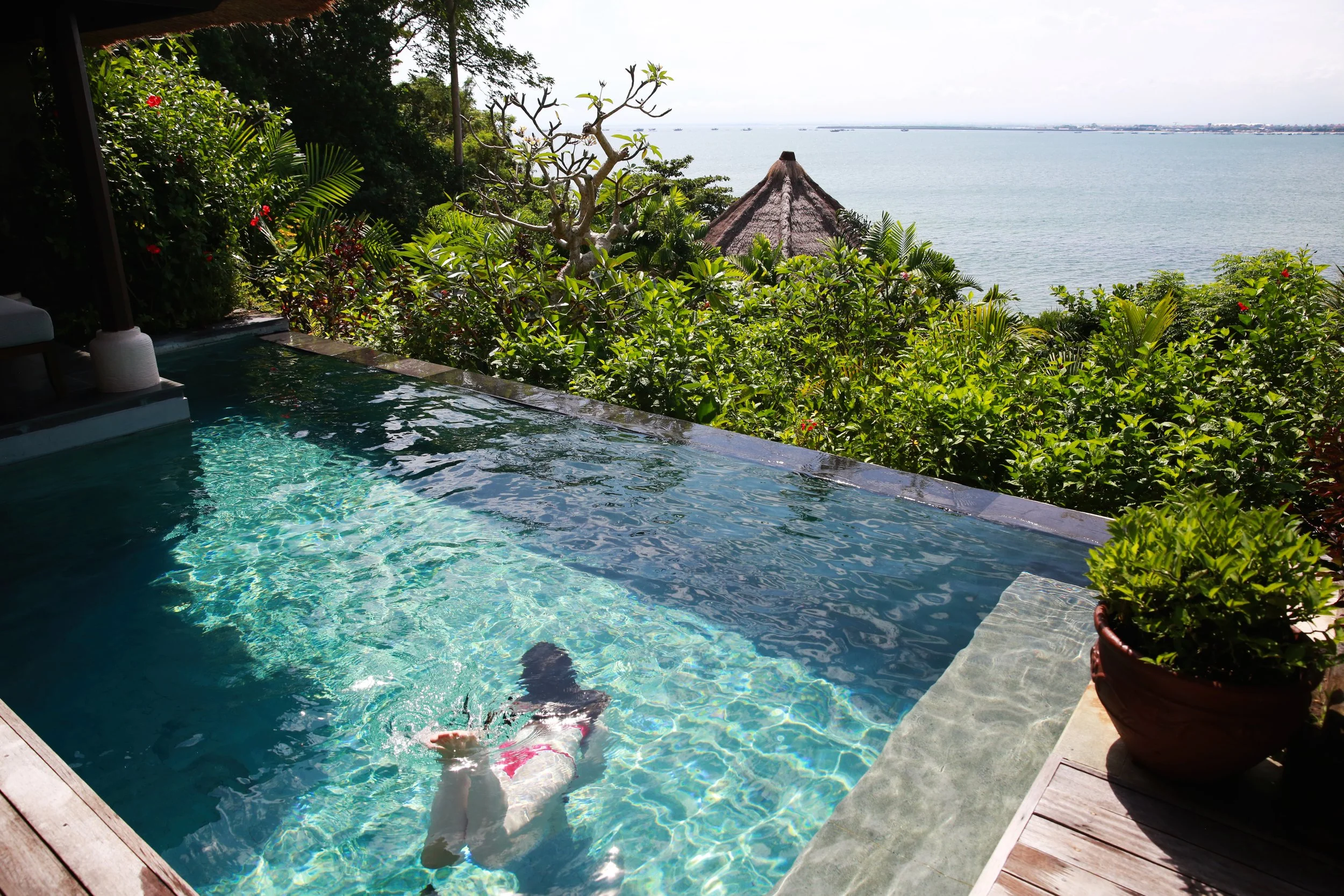
Her upbeat mood only improved as we arrived at Four Seasons Resort Bali at Jimbaran Bay. In our family, we also joke that Oona is a bit of a low-key snob, the kind of person who pretends she’s into anything but, deep down, really appreciates the nicest things. The property is that: lush and green, sprawling over a hillside overlooking the quiet end of the bay, with a wide expanse of blue sky touching an equally blue sea.
It looks not dissimilar to the hotel featured in Season 3 of The White Lotus and was actually in consideration for the show; I was told by a disappointed staff that the Thailand property was selected the week before the show’s production team was scheduled to visit the Bali location. Villas are built in traditional Balinese style, with dark wood, lots of space, and a raised threshold that prevents bad spirits from entering. When we finally got inside, I threw open the doors while Oona flopped on the bed, which the staff had covered in flowers.
She let out a long, satisfied exhale: “Oh, this is really nice.”
Then she drew a hot bath and stewed in it, something she proceeded to do twice a day for the rest of our trip. I find baths painfully boring; I only used the outdoor shower, which she avoided for fear of spiders.
When the properties had proposed our schedule, I had noticed some potential bumps. Often what appealed to one of us didn’t appeal to the other. Every single one of the spa offerings sounded great to me, but Oona wasn’t even sure she was comfortable getting a massage. She was equally unexcited by the antigravity yoga class I was looking forward to. And as soon as I saw The World’s Only Check-In by River Raft on the schedule, I knew it was an adventure she would love and I would hate.
Our first spa experience, scheduled for that afternoon, was a Gemstone Joy Treatment, combining gemstone oils with massage stones and a crystal-wand mini-facial. For me, the biggest thing recommending it was its length: two blissful hours. Despite her misgivings, Oona had agreed to try a massage (and I had agreed to river rafting). But by the time we arrived at the spa, she was resistant. If I’m being generous, I’d say she embarked on the experience begrudgingly, with a push from me.
At the beginning of those two hours, my mind was on Oona, hoping she was okay. But after the first few minutes, that concern vanished, along with all others. Drifting in and out of consciousness, being massaged, listening to singing bowls … It was delightful.
As the masseuses left the room, Oona turned to me from the next bed.
“Okay,” she said with a sigh. “You were right. That was amazing.”
She also rolled her eyes a little at me. Because she’s 13.
Antigravity yoga offered another surprise, this time for me. I’m sorry to report that I hated it. The silks cut into my thighs, I felt clumsy, and, although I have done yoga for years, totally inflexible. It was a humbling experience that brought me right back to the horrors of middle school gym. Oona, on the other hand, excelled at it, as she does at all physical things. It was a joy to watch her hanging upside down, utilizing her incredible physicality, which does not come from me.
The following day Oona had a surf lesson scheduled with Tropicsurf. Her instructor, who exuded a very Aussie combination of competence and chill, told me they often take guests out to more dynamic spots, but Oona was happy to surf the resort’s private beach, which meant that I got to lay on a lounge chair and watch. I put my phone down and just listened to the water, appreciating seeing my kid — at home in her body in a way I will never be — surf wave after rolling blue wave. I thought about how hard I had worked when I was younger to keep moving. I felt grateful that at least for this moment, I could stop and be present in this beautiful place.
I was not able to carry the calm I found on that beach into river rafting. I cannot emphasize enough how much I was dreading this activity, which had been haunting me since I’d agreed to it. Thrills are not something I seek. I dislike amusement parks, roller coasters, and scary movies. I have enough trauma without additional inputs setting off alarms that something bad is about to occur.
As we were dropped off at the Ayung River, I wistfully watched our luggage depart (by car) for the next hotel, wishing I could go with it. Kitted up in a life jacket and helmet, carrying a paddle, I marched down the 200 steps that switchbacked into the ravine. I could hear the river before I saw it, along with the screaming of other rafters. Looking back at Oona, I could see that, just as much as I was dreading this, she was looking forward to it, so I tried to get a grip. The rafting headquarters had displayed an oversized banner featuring photos of former United States President Barack Obama from when he visited; I calmed myself by reasoning that if the Secret Service allowed him to do it, then surely it was safe.
As soon as we got into the raft, I realized I was going to be just fine. Class IV rapids sounded scary, but they weren’t. The day was hot, and it was a relief to be splashed by the cold water. The gorge the river cut through was beautiful, with high-banked cliffs on either side covered with deep, green jungle. Monkeys were swinging around in the trees. Every so often, there was a small fruit and juice stand along the riverbank, where other rafts had pulled up for refreshments. Our guides were experienced and confidence-inspiring, which certainly helped. But more than that, it was fun. “See, Mom?” Oona said. “I told you it wouldn’t be that bad.” She was right; I had been carrying all this dread for nothing. Just like Oona with the massage, I couldn’t know what I didn’t know without trying it.
The raft took a final turn and pulled up to a dock, depositing us, as promised, at Four Seasons Resort Bali at Sayan, where we spent the second half of our stay. Located near Ubud, the hotel’s main building is modeled after a rice bowl, but from below it looks more like a spaceship that has been dropped into the verdant valley. The whole property is surrounded by water. Between the villas, rice paddies are cultivated by local farmers. We could hear the river everywhere; at night, the air was alive with frog sounds.
The activities and spa programs at both properties have been designed to reflect a core Balinese concept of sekala and niskala. Literally translated, the words mean “of time” and “out of time,” respectively, but in culture they refer to the “seen” and “unseen” in life, the balance between body and spirit. At Jimbaran Bay, sekala is reflected in surfing, watersports, the show-stopper surroundings. In the hush of Sayan, the focus is on niskala. There, I practiced morning yoga on a platform overlooking the rice paddies; enjoyed a spa treatment called Tirta Ening: a two-and-a-half-hour ritual inspired by local customs that involved being massaged, scrubbed, and repeatedly doused in water; and Oona and I experienced a Sacred Nap, which had us wrapped up in hammocks and swaying in the breeze for an hour as a woman with a lilting voice told us a bedtime story.
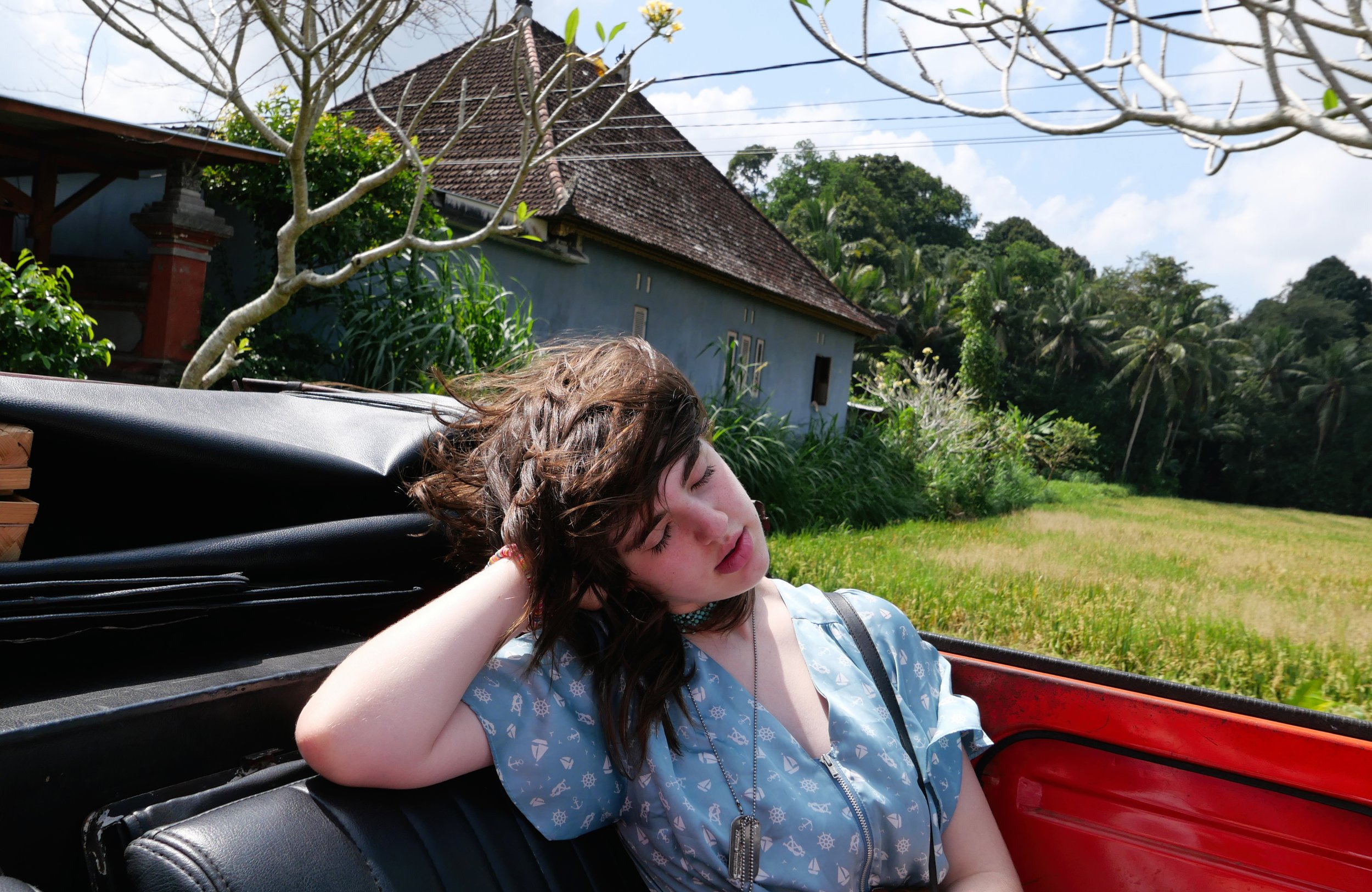
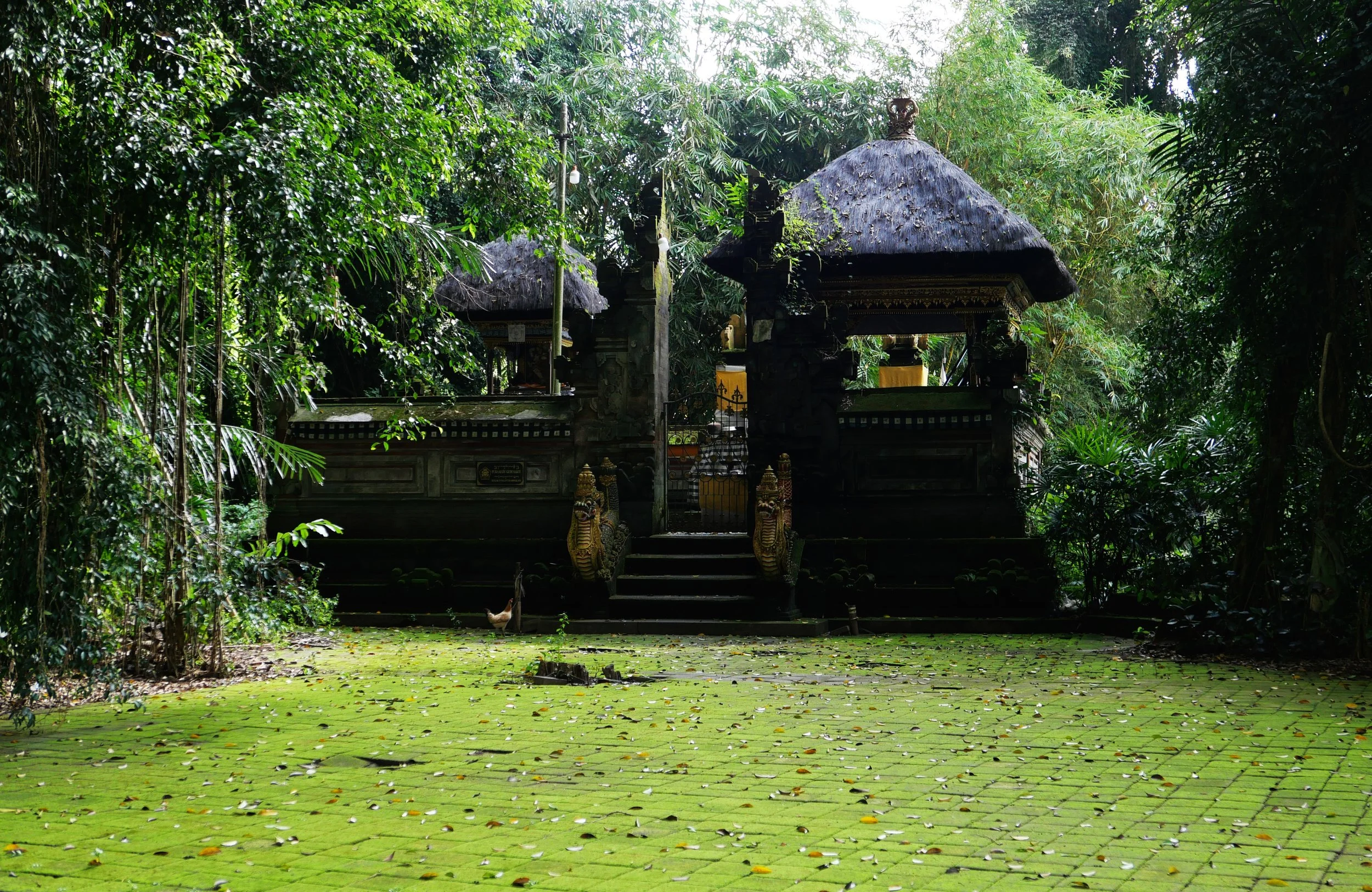
A concerted effort has been made to introduce guests to Balinese culture off-property as well. An experience called Can You Keep a Secret saw us departing the hotel in an open-topped, bright orange Volkswagen 181 from the 1960s. As we left busy main highways for empty backroads, the often crowded outer face of Bali gave way to something quite different. A tour of an empty local temple (which I was asked not to name or post about on social media to help keep it that way) was followed by a visit to a neighboring family’s home, where we learned to make canang sari, small baskets of daily offerings. Afterward, we brought these to another temple, where we were invited to participate in melukat, a purification ritual. Oona skipped it, watching me instead. Wrapped in a sarong, I kneeled in front of a priest to receive a blessing before queuing up to immerse myself in a communal bath. At each of the seven waterspouts, I was instructed to offer a silent prayer before submerging my head. The day was hot, and the water was so icy that it took my breath away. The shock helped me be present, to let the water overcome me, to wash me clean of the past and anything else I wanted to shed.
Our last night at Sayan, Oona and I ate at Sokasi Cooking School, which offers an intimate chef’s table interpretation of traditional Balinese food cooked over an open flame. I felt pride watching my 13-year-old daughter eagerly try everything on the seven-course tasting menu. (“I’m glad you force me to try different foods,” she’d said earlier in the stay, when she’d overheard a nearby teenager ordering off the kids menu, “or else I would have missed out on so many delicious things here.”)
As we ate, we talked about our trip. My favorite experiences were morning yoga and melukat. Oona told me hers had been a tour of the gardens in Jimbaran Bay, which ended in her adopting a beehive (an activity I had been concerned she was too old for), and the property’s breakfast buffet, which she declared to be one of the best she had ever seen. We both loved the massages and rafting. And she liked antigravity yoga. I asked her what about it she had enjoyed.
“Don’t take this the wrong way,” she said, “but I liked seeing you do something you weren’t good at.”
There are so many things I’m not good at. I know this now and embrace it in a way I couldn’t imagine when I was young. Humility is an enormous gift of aging, accelerated, frankly, by parenting. I was glad Oona had seen me try something I was so inept at. Often as a parent, you try to be unimpeachable, but it’s not true, and those façades are a barrier to connection. In order to truly connect, you have to let your guard down. Humiliating yourself and conquering your fears are great steps toward doing so.
Stepping off the plane as we arrived back home, I noticed on one side of us two young parents carrying a small, sleeping baby. They looked nervous and unsure, laden down with all of this tiny creature’s accoutrements. On the other side were two girls in their very early 20s, wearing tube tops, neck pillows, yoga pants. They were friends returning from an adventure.
Oona and I were standing right there in the middle. And for now, at least, she was still holding my hand.